Table of Contents
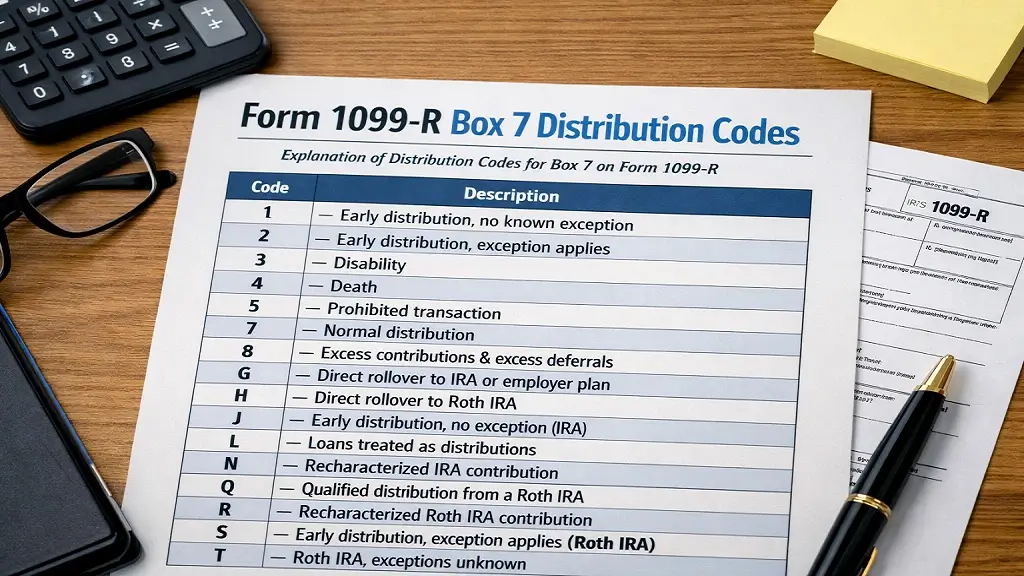
ToggleBox 7 on Form 1099-R uses alphanumeric codes. Ideally, to tell the IRS if your retirement distribution is:
- Taxable
- Subject to a 10% penalty
- A tax-free rollover
Common codes include 7 (Normal), 1 (Early), and G (Direct Rollover).
Quick Reference: 1099-R Distribution Code Meanings
So you just opened your mail and found a Form 1099-R. You probably see a bunch of numbers. Your eyes might land on Box 7. This tiny box holds a code. That code tells the IRS if you owe them money.
It can be a number or a letter. If you ignore it, you might get a surprise tax bill. Let’s break down these codes in plain English so you can file with confidence.
| Code | Description | Key Tax Impact |
|---|---|---|
| 1 | Early distribution (No known exception) | 10% penalty + income tax |
| 2 | Early distribution (Exception applies) | Income tax only (No penalty) |
| 7 | Normal distribution | Income tax (Standard) |
| G | Direct Rollover | Generally tax-free |
| J | Early distribution from Roth IRA | Tax/Penalty on Earnings only |
Understanding Common Box 7 Codes
Commonly, Box 7 on 1099-R shows these codes:
Code 7: Normal Distribution
This is the “safe” code. It means you are older than 59 ½. The IRS sees it as a standard retirement move. You will pay regular income tax on the amount. But you won’t pay any extra penalties. Most people see this on their 1099-R once they stop working.
Code G: Direct Rollovers
Think of Code G as a “bridge” between two accounts. You moved money from a 401(k) to an IRA. Or maybe you switched jobs. The money never touched your personal bank account. Because of that, it is almost always tax-free. However, you still have to tell the IRS about the move. Use Code G so they know you didn’t just spend the cash.
Quick Note: Code G is incredibly common because Americans move around. With $9.3 trillion currently held in 401(k) plans, millions of people trigger Code G every year when they switch jobs. Reporting it correctly is the only way to prove that your share of that trillions isn’t taxable income.
Code 1 vs. Code 2: Early Distributions
These two cause the most confusion.
- Code 1 is the “penalty” code. You took money out before age 59 ½. The IRS will likely take an extra 10% on top of your taxes.
- Code 2 is better. It means you are still young, but you have a special reason to avoid the penalty. Maybe you set up a specific payment plan. It’s like having a hall pass from the IRS.
You aren’t alone if you’re tapping into your retirement early. In 2025, a record 6% of 401(k) holders took hardship withdrawals. That’s up from just 2% before the pandemic. Because more people are taking money out, the IRS is watching Box 7 codes more closely than ever.
Rare & Complex Distribution Codes
1099-R Box & doesn’t stop on 3 simple codes, there are multiple others that can show up!
Codes for Roth IRAs (J, Q, T)
Roth accounts have their own rules.
- Code J means you took Roth money early. You might owe taxes on the profit, but not the original deposit.
- Code Q is the winner. It means your Roth withdrawal is totally tax-free. You met the five-year rule and the age rule.
- Code T means the bank isn’t sure if you met the five-year rule yet. You might need to check your own records.
Death and Disability Codes (3 & 4)
Sometimes life happens.
- Code 3 shows up if you are disabled. It usually stops the 10% penalty.
- Code 4 means the money went to a beneficiary after someone passed away. These are sensitive but usually come with tax protections.
Administrative & Special Event Codes
Sometimes Box 7 isn’t about a standard withdrawal. These codes often appear when you’re fixing a mistake or moving insurance policies.
| Code | What it Really Means | Why You See it |
|---|---|---|
| 6 | 1035 Insurance Exchange | You swapped one insurance or annuity policy for a better one tax-free. |
| 8 | Excess Contribution (Current Year) | You put too much money in your account this year and had to take it back. |
| P | Excess Contribution (Prior Year) | Same as Code 8, but the mistake happened last year. You may need to amend a return. |
| S | SIMPLE IRA Early Payout | You took money from a SIMPLE IRA within the first 2 years. Beware: The penalty is 25%, not 10%. |
| W | Long-Term Care | Money was taken out to pay for qualified long-term care insurance premiums. |
New for 2026: The "Combo" Codes
In 2026, the IRS started using specific letter combinations to make filing easier for retirees. You might see two characters in Box 7 now.
- Code Y7 (Qualified Charitable Distributions): If you are over 70 ½ and gave money directly from your IRA to a charity, you’ll see this. It tells the IRS the money is not taxable.
- Code JS (Roth SIMPLE IRA): It’s brand new for 2026. It’s for people who took money out of a Roth SIMPLE IRA early (within the first 2 years).
- Code 1P or 18: Means you had an “Early Distribution” (1) plus an “Excess Contribution” (P or 8). It means you took out too much money and you did it before you were 59 ½.
Avoid These Common 1099-R Reporting Errors.
If your form says Code G but you forget to report it, the IRS gets nervous. They see a payout but no proof of a rollover. They might send a letter asking for taxes you don’t actually owe.
Also, keep an eye on Code 1. Even if the bank puts Code 1, you might still qualify for a penalty waiver. This happens with medical bills or first-time home purchases. You just have to file an extra form to claim your “pardon” from the IRS.
The Cost of Mistake in 1099 R Filing:
Small errors lead to big bills. The IRS assesses billions in penalties every year for early withdrawals. In fact, if you miss a simple exception for a $10,000 withdrawal, you could end up paying a $1,000 penalty that you didn’t actually owe. Just because a code was entered wrong.”
Final Wrap Up:
Check your codes twice before hitting send. It saves hours of headaches later. And if you are planning to file it with zero stress, opt for E-file Workforce Payroll Software. Our forms are intuitive and help you file securely while saving time and mental energy.
FAQs: Common Questions About Box 7 Codes
Where is the code on my form?
Look at the right side of your 1099-R. There is a small box labeled Box 7. The code sits right there.
Can Box 7 have two codes?
Yes, it can. Sometimes a letter and a number sit together. Usually, it happens when two different rules apply at once. Also, you might see 7Y (a new 2026 code for Qualified Charitable Distributions)
What is the 1099-R Code R?
It means you “recharacterized” a contribution. Basically, you moved money back out because you changed your mind on the account type.
What if my code is wrong on the form?
Don’t just change it! Contact the bank for a Corrected 1099-R. If they won’t budge, file Form 5329 to claim an exception. Matching the IRS’s records is vital to avoid automatic red flags and “surprise” penalty bills.