
File 1099-DIV Online
E-File Workforce Payroll, a modern way to file 1099-DIV Online hassle-free, can help you boost your filing efforts.
Understanding 1099-DIV Form:
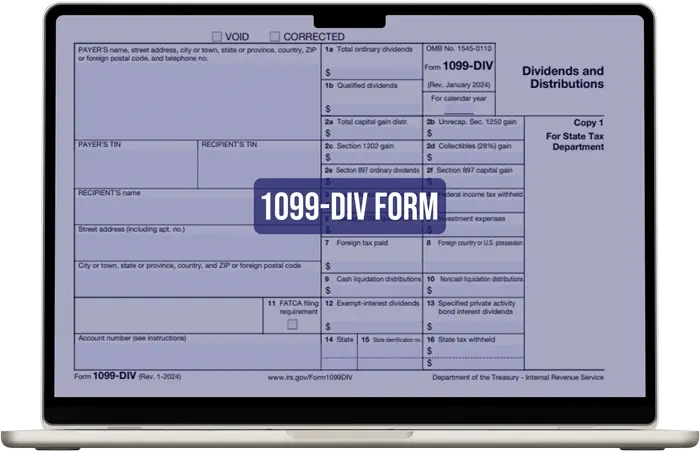
Form 1099-DIV, “Dividends and Distributions,” is an IRS document used to report income from certain distributions that you have received in a tax year. This form has two purposes:
- To report dividends and other distributions from investments such as stocks, mutual funds, and corporations. It’s different from form 1099-INT (reports interest income).
- It provides information to both taxpayers and the IRS, ensuring accurate reporting of dividend income.
Key Information Reported on 1099-DIV:
The form is for distribution and dividend reporting purposes. Information reported on Form 1099-DIV includes:
- Ordinary dividends: These are the portion of the company’s profit that is deposited on a regular basis in the shareholders accounts.
- Qualified dividends: These are dividends that meet specific IRS requirements and are taxed at lower rates.
- Capital gain distributions: These are distributions of capital gains from mutual funds and other investments.
- Federal income tax withheld: The amount of federal tax withheld from your income through dividends.
State income tax with held: Any state taxes withheld from your dividend income.
Who Needs to File Form 1099-DIV?
Financial institutions such as brokerage firms, banks, and mutual fund companies usually issue these forms to individual taxpayers. Along with the 1099-DIV, these institutions often issue Form 1099-B, Form 1099-MISC, and Form 1099-OID.
They are typically responsible for filing 1099-DIV online for individuals who got more than $10 from them.
Although the documentation is necessary for investors as well to report accurate income,. However, they don’t need a physical form submission to do so. Another key consideration to keep in mind is that even if an investor does not receive a 1099-DIV, they are still responsible for reporting all taxable dividend income.
Filing Deadlines for 1099-DIV:
When talking about deadlines, it is crucial to understand that filing deadlines for brokerage firms are different than those for individual taxpayers. Here is a breakdown:
- A financial institution must send a copy of 1099-DIV to an individual by the end of January.
- Paper filing dates for financial institutions are February 28th.
- E-filing date is March 31st.
- Individual taxpayers use this information when preparing their tax returns, and their dates are typically April 15th.
Key Note: There are some exceptions to this rule. For example, if you are a trustee or mediator of a Widely Held Fixed Income Trust (WHFIT), then the recipient deadline is March 17th.
Step-by-Step Procedure to E-File:
Time to file 1099-DIV online! Use E-File Workforce Payroll. Here is a step-by-step approach to submitting your tax document to the IRS:
- Make an account or log in to your existing account with E-File Workforce Payroll. You can create one quickly by providing essential details.
- Once you log in, there will be a dashboard with a menu in the left bar.
- Choose filing and then “Start New Filing” from the menu. A short form with two drop-downs will appear.
- Select your filing year and form, respectively.
- From the next screen, fill out all necessary filing details and generate copies to send to recipients.
All done, you have complete filing through a modern system that won’t take more than five minutes.
Rule: You must have all the details gathered before starting the filing process.
Have Questions?
Simpler than you think!
Your Questions, Answered Here!
1099-DIV is a tax document used to report distributions and dividends from a financial institution that can be a bank or brokerage firm. It details the dividends and other distributions paid to investors during the tax year.
1099-DIV is required to be sent out on January 31st to all recipients. However, if you are a middleman of a Widely Held Fixed Income Trust (WHFIT), then the recipient deadline is March 17th.
Cash liquidation distribution is very tricky to report on 1099-DIV. It is primarily based on capital gains or capital returns, depending on the circumstances. Often, these types of distributions will be reported in box 2a of the 1099-DIV, and then, depending on the specific type of distribution, they will be reported on Schedule D or Form 8949. If you are getting puzzled about these details, it’s better to consult a professional tax preparer.
The $600 threshold is for Form 1099-MISC and some other form in the 1099 series. However, it doesn’t apply to 1099-DIV. If you have paid more than $10 to an investor, you must file 1099-DIV.
Whether you received a 1099-DIV or not. You still need to file accurate dividends on tax returns. For that purpose, keep a clear record of all transactions (specifically about dividends and stocks). Ask your financial institution for details and request a 1099-DIV if they are responsible for issuing one.
Testimonial
E-file Workforce Payroll is secure and efficient, and it allows me to easily access and submit multiple payroll forms with features like IP restriction and multi-user access for my team. It’s also been a big help in ensuring accuracy, as I can easily file corrected and void forms whenever necessary.
Highly Recommended!
Business Owner
Today is a challenging world. With a conventional tax form filing system, it has not been possible for my firm to deal with multiple employees. While exploring top-ranked e-filing applications, I found them inefficient. So, I chose cloud-based E-File Workforce Payroll. This application is efficient and user-friendly. More importantly, I can manage my employees’ payroll even on my vacations.
Highly Recommended!
Business Owner
If you seek the most reliable and affordable e-filing platform, we ensure only a few can match the standards and rates set by E-File Workforce Payroll. They are experienced, informed, professional accountants and web developers who understand the US payroll form filing system and comprehensively fulfil all professional accountants’ requirements.
Alastair BrookManager